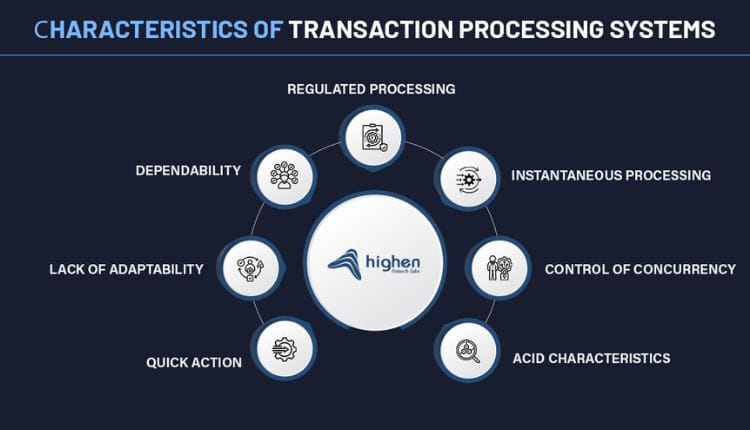

In today’s online world, we are making payments more frequently. From buying items on e-commerce sites to handling monetary transactions on internet banking solutions, the smooth execution of these payments depends on a transaction processing system.. This post describes the importance that transaction processing has in order to support and secure Internet-based payments, and also looks at its critical components, as well as its mechanisms, roles, and presence in the contemporary business environment.
Understanding Transaction Processing
In a retail environment, every sale, return, void, discount, or payment processed at the register is a transaction that must be recorded accurately and in real time. Transaction processing refers to the disciplined management of these individual business transactions to ensure that the underlying database is updated correctly and consistently. At a high level, a transaction is a collection of related steps that must either all succeed or all fail in order to maintain data integrity.
With respect to an online transaction, transaction processing verifies that the payment is properly recorded, processed, and accounted for in respective customer and merchant accounts. This preprocessing function is crucially important to avoid mistakes and fraud, building trust in online payment systems. In other words, transaction processing is the foundation of any system that has to ensure effective and consistent updates to data.
Key Components of a Transaction Processing System
TPS is a system of several parts that work together to process online transactions. Such components may include input components for receiving transaction data, processing components for processing the data to determine, among other things, whether or not the data is valid, and output components for recording the results of transactions. The transactional data is maintained in a central database system, which is usually relational, and certain properties are guaranteed by a transaction management module.
| Property | Description |
| Atomicity | Each transaction is treated as a single, indivisible unit. |
| Consistency, Isolation, Durability (parts of ACID) | Maintains data integrity even in the face of system failures. |
Moreover, the TPS must have security attributes to prevent unauthorized access and modification of transaction data, which is regarded as sensitive. Learning how each of these components fits together, and how transaction processing works, is very important when you build your own online payment system. The system should be able to serve queries on heterogeneous workloads and should support high query performance.
Importance of Transaction Processing in Online Transactions
Transaction processing is a critical success factor for all online transactions. It is the basis for secure, trustworthy, and fast payment processing for online commerce and banking. Online transactions are typically processed using OLTP systems, which are meant to process large volumes of transactions in a short time span.
That is why merchants and payment providers rely on strong transaction processing systems to guarantee security and compliance, and, to a lesser extent, have issues such as lack of conformity, which impact consumer confidence and the continued growth of the digital economy. Also, transaction processing can be designed to maintain adherence to standards and regulations that require that certain types of data, including payment card data as required by the PCI DSS, be provided a certain level of protection.
If companies have strong processing systems in place, they can keep transaction information safe and prevent loss of money and reputation. The high volume of access traffic and the fast response time are also important for a good customer experience in online shopping and other online services, so the scaling and data management of the system are needed.
Types of Transaction Processing Systems
Different kinds of transaction processing systems support different needs. A TPS (Transaction Processing System) can be implemented in a number of ways depending on the nature of the business transactions. Not only does a TPS pertain to speed but it will ensure data integrity and reliability for all transaction data processed.
| System Type | Characteristics |
| Online Transaction Processing (OLTP) | Manages and facilitates online transactions that require immediate real-time processing, handling a large number of transactions concurrently. |
| OLTP Applications | E-commerce platforms, online banking, and reservation systems where immediate updates and confirmations are essential. |
For instance, order entry systems are commonly OLTP.
Differences Between OLTP and OLAP Systems
Although OLTP and OLAP are both related to processing transactions, they were created to serve different functions.
- OLTP: A system designed for transaction processing, with each query responding with a fast response time. Such systems concentrate on processing in real time and enforcing data consistency.
- OLAP: Online Analytical Processing systems are flexible systems for complex inquiry and analysis of historical transaction data. OLAP systems aid in the decision-making process by presenting a detailed history of business transactions.
| Characteristic | OLTP | OLAP |
| Focus | High number of transactions, quick response time, real-time processing, data integrity | Complex query and analysis of historical transaction data |
| Purpose | Processing transactions | Extracting insights and trends from large volumes of transactional data |
OLAP is typically based on a database with summarized and aggregated data. Thus, if processing is critical to OLTP, querying is essential to OLAP.
Distributed Transaction Processing Systems
A distributed transaction occurs when business operations span multiple databases or systems. These systems rely on advanced transaction management strategies to achieve atomicity and consistency among all the nodes in the system. A significant difficulty is ensuring consistency of the data when facing network crashes or system failures. Algorithms such as two-phase commit are employed to ensure that either the entire transaction completes successfully, or none of it does.
Scaling such systems for high transaction volumes can be challenging and needs to be carefully designed and optimized. Distributed transaction processing occurs in domains like banking and finance, where online transactions span various institutions or accounts. The explosive growth of cloud computing has also been the catalyst for the huge demand for reliable distributed transaction processing, combined with the need to spread both applications and transaction data across multiple servers at diverse locations. The system should verify each transaction before completion. Under such circumstances, it is imperative to learn about transaction processing.
Functions of Transaction Processing
Atomicity is one of the most fundamental properties of transaction processing, particularly in online transaction systems. The atomicity rule says that it is impossible to perform an operation only partially; if a transaction is only partially completed, it must be as if the transaction never took place. All transactions are successfully executed, or nothing is. This is the pertinent principle for data integrity.
For example, if a financial transaction involves debiting one account and crediting another, atomicity guarantees that if the debit occurs, the credit also will occur. In case of failure of any of the steps, the operation as a whole, including all its side effects in all its parts, is rolled back, and the database system remains in the state it was before any transaction was issued. This is a guard against opportunities for discrepancies and mistakes that could lead to lost funds or inaccurate transaction information. To produce reliable systems, you have to understand how to process transactions, so the processing is also important.
Managing Workload in Transaction Processing Systems
Transaction processing systems must be able to effectively handle varying demand loads. Part of that is scaling the system to peak transaction volumes while not sacrificing response times or data integrity. Performance of querying is improved through techniques including, but not limited to, indexing and partitioning of data. OLTP databases are optimized for dealing with a large number of transactions at once, sometimes with abstraction layers to reduce overhead (through means such as connection pooling or caching).
The mechanism should also prioritize transactions by their urgency and importance, whereby critical transactions are handled with high priority. Load balancing on multiple servers is another method for load distribution to avoid hot spots. This ensures data processing remains efficient, keeping online and business transactions responsive and reliable under heavy loads.
Handling Transactional Data
Transaction management refers to the management of data involved in transactions from their inception to their completion. This encompasses the sensitive entry and collection of transaction data, verifying the accuracy and completeness of that information, as well as storage and retrieval. Data cannot be corrupted, which implies the need for comprehensive error handling and checking of the data at the entry points.
Transactional data necessarily needs to be stored in a structured format in relational databases for the sake of easy searching and reporting. Control mechanisms are provided to protect the release of sensitive transaction information to unauthorized staff. In addition, transaction logs need to be retained for audit purposes as well as for compliance. There is a need for sound management of transaction data to ensure trust and confidence in online transactions. Part of transaction processing is the ability to verify and protect customer data.
Managing Workload in Transaction Processing Systems
Transaction processing systems must be able to effectively handle varying demand loads. Part of that is scaling the system to peak transaction volumes while not sacrificing response times or data integrity. Performance of querying is improved through techniques including, but not limited to, indexing and partitioning of data. OLTP databases are optimized for dealing with a large number of transactions at once, sometimes with abstraction layers to reduce overhead (through means such as connection pooling or caching).
The mechanism should also prioritize transactions by their urgency and importance, whereby critical transactions are handled with high priority. Load balancing on multiple servers is another method for load distribution to avoid hot spots. So, data processing is carried out with high efficiency to keep online and business transactions responsive and reliable under heavy loads.
Handling Transactional Data
Transaction management refers to the management of data involved in transactions from their inception to their completion. This encompasses the sensitive entry and collection of transaction data, verifying the accuracy and completeness of that information, as well as storage and retrieval. Data cannot be corrupted, which implies the need for comprehensive error handling and checking of the data at the entry points.
Transactional data necessarily needs to be stored in a structured format in relational databases for the sake of easy searching and reporting. Control mechanisms are provided to protect the release of sensitive transaction information to unauthorized staff. In addition, transaction logs need to be retained for audit purposes as well as for compliance. There is a need for sound management of transaction data to ensure trust and confidence in online transactions. Part of transaction processing is the ability to verify and protect customer data.