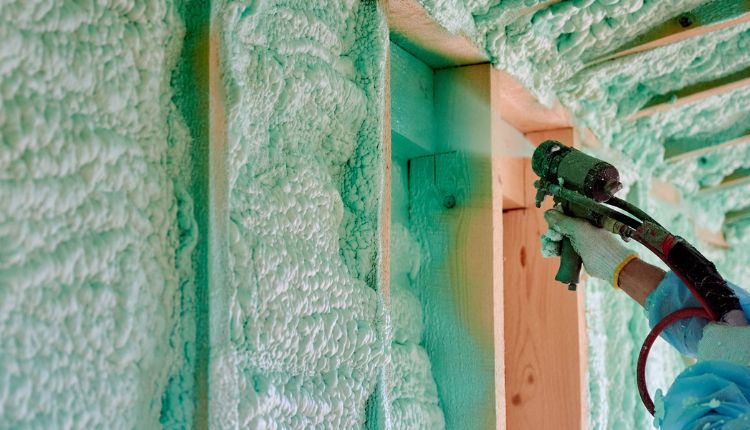

Multi-story homes often look well-designed on paper, but feel uneven in daily use. The lower floor may stay cool while the upper rooms trap heat, or winter mornings may leave one level comfortable and another stubbornly cold. That imbalance is not simply an inconvenience. It affects energy use, indoor comfort, and how hard heating and cooling systems have to work throughout the year. Spray foam has become an important part of solving this problem because it helps control the hidden air movement and temperature drift that make stacked living spaces harder to manage than single-level homes.
Why Vertical Homes Lose Balance
What Drives Floor-To-Floor Temperature Swings
Thermal instability in multi-story homes usually starts with the way air and heat move vertically through the structure. Warm air rises, and in homes with leaks around framing joints, attic transitions, wall cavities, and floor penetrations, that movement becomes far more pronounced. The result is a stack effect that pulls conditioned air away from some areas and pushes unwanted heat or cold into others. Conventional insulation can slow heat transfer, but it often leaves the tiny gaps and irregular openings that allow air to keep moving through the building shell. Spray foam changes that equation because it expands into those voids, creating a more continuous barrier against both air leakage and thermal drift. In homes where upper floors regularly feel disconnected from the rest of the structure, Spray Foam Insulation is often considered because it improves control of the building envelope, rather than asking the HVAC system to compensate for leakage all day. That matters in multi-story layouts, where even small defects become more noticeable from floor to floor.
Air Sealing Improves Whole-Home Consistency
One of the main reasons spray foam improves thermal stability is that it combines insulation with strong air sealing. In a multi-story house, that combination is especially useful because temperature imbalance rarely comes from one source alone. It comes from the interaction of heat flow and uncontrolled air movement between floors, attics, exterior walls, and ceiling assemblies. When spray foam is installed in critical parts of the envelope, it reduces the pathways that allow conditioned air to escape and outside air to enter. That helps each level hold its intended temperature more consistently, rather than constantly drifting toward conditions outside or above. The difference is often felt in rooms that used to overheat in the late afternoon, in hallways that stayed drafty, or on upper floors that forced the thermostat to be adjusted far too often. By limiting air exchange through hidden cracks and cavities, spray foam helps make the house a more stable thermal system. Instead of one floor borrowing comfort from another, the structure begins to hold conditioned air where it belongs.
Upper Floors Benefit From Stronger Envelope Control
Second- and third-floor areas tend to reveal thermal problems first because they sit closest to the roofline and because rising air pressure from below intensifies heat gain and loss in those areas. In summer, upper-story rooms often absorb roof-related heat more quickly, and in winter, they may experience stronger temperature fluctuations as conditioned air escapes upward through the attic boundary. Spray foam helps by tightening these vulnerable transitions and reducing how much the upper levels are exposed to shifting outside conditions. When roof slopes, attic kneewalls, bonus-room ceilings, or wall cavities are treated properly, the upper part of the house becomes less reactive to outdoor temperature swings. This can make bedrooms, offices, and flex rooms feel more predictable from morning to night, when thermal stability becomes most noticeable to occupants. Instead of relying on constant thermostat changes to force balance across levels, the house begins to resist those swings at the envelope level. That is one of the most practical reasons spray foam changes the comfort profile of taller homes more dramatically than many owners expect.
Why Multi-Story Homes Need Stronger Thermal Control
Spray foam improves thermal stability in multi-story homes by addressing one of their biggest weaknesses: the tendency for air and heat to move unevenly through stacked living spaces. Sealing gaps, reducing vertical air leakage, and strengthening the thermal boundary around upper floors helps the house resist the floor-to-floor imbalance that often drives comfort complaints. The benefit is not limited to energy savings or building science language. It shows up in quieter temperature swings, more usable rooms, and heating and cooling systems that no longer have to fight the structure itself to maintain comfort. In taller homes, that kind of stability makes the entire property feel more controlled, more efficient, and far easier to live in every season.